
Patch-Patch rules
Patch-Patch is a poker game for two or three players. Everyone gets 12 cards and splits them into three hands of four, one for each of three boards. Each hand plays its own board the way an Omaha hand does: exactly two of its four cards with exactly three of the board's five. There is one pot, and each board pays a third of it. Win all three boards and you scoop the whole pot.
This page is the complete rulebook, written from the game's own code: what you see at a Patch-Patch table is what is described here.
The game at a glance
| Patch-Patch | |
|---|---|
| Players | 2 (heads-up) or 3 |
| Your cards | 12, split by you into three hands of 4 |
| Boards | 3, each with its own flop, turn and river |
| Making a hand | Exactly 2 of the hand's 4 cards + exactly 3 of its board's 5 |
| Betting | Pot-only: check or bet the pot; fold, call or raise the pot |
| Betting rounds | 4: before the flops, on the flops, on the turns, on the rivers |
| The pot | One pot; each board pays a third of it |
| Showdown | All three boards at once |
The deck and the seats
Patch-Patch uses one standard 52-card deck. Three players take 36 cards between them and the three boards take 15, so a three-handed hand uses 51 of the 52 cards. Heads-up, 39 cards are in play and 13 are never seen. That is why a table seats two or three players and no more.
The button moves one seat clockwise after every hand. Two blinds start the betting: the small blind and the big blind. Three-handed, the seats are the button, the small blind and the big blind. Heads-up, the button posts the small blind. Public tables run from 5-10 blinds up to 500-1000, and you bring from 5 to 150 big blinds to a Patch-Patch table.
A hand, step by step
1. The deal
Each player is dealt 12 cards face down. Nobody else sees them, and nothing is arranged yet: the first four sit beside board 1, the next four beside board 2, the last four beside board 3.


2. Betting before the flops
There is one round of betting before any board card is seen. The first to act is the player after the big blind: three-handed that is the button, heads-up it is the small blind (who is also the button). You can fold, call the big blind, or raise the pot. You are betting on twelve cards and on how well they can be split, not on one hand.
3. The three flops
Each board gets its flop, three cards face up, all three boards at once. Everyone shares them: a board's cards play for every player's hand on that board.
4. The arrangement
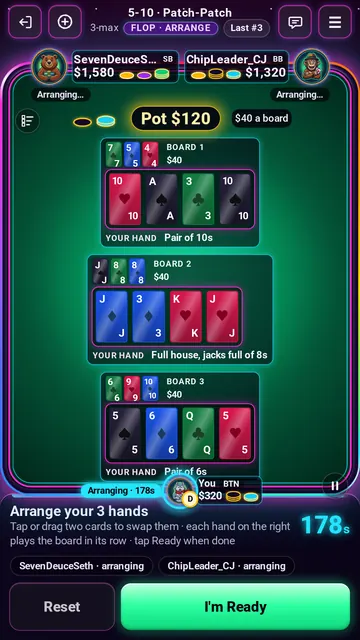
Now, with the three flops in front of you, you split your 12 cards into three hands of four. The four cards beside board 1 play board 1, and so on. At the table you tap a card and then another to swap them (or drag one onto the other), and tap I'm Ready when your three hands are set. The hand under each board shows what it makes as you go.
Everyone arranges at the same time, and nobody sees anyone else's arrangement until the showdown. The arrangement has its own clock: 3 minutes at slow tables, 2 at mid, 100 seconds at fast. When it runs out, the arrangement on your screen is sent as it is. Once the arrangement phase ends, your three hands are fixed for the rest of the hand.
5. Betting on the flops
The second round of betting starts with the first player still in the hand to the left of the button: three-handed that is the small blind, heads-up it is the big blind. From here on the button acts last.
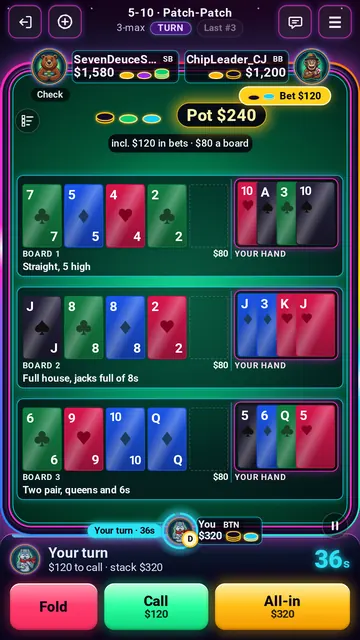
6. The turns
Each board gets a fourth card, its turn, and there is another round of betting.
7. The rivers
Each board gets its fifth and last card, its river, and there is a last round of betting.
8. The showdown
If two or more players are still in the hand after the last round, every hand is shown and the three boards are decided at once. On each board, the best five-card hand made with exactly two of that board's four hole cards and three of its five board cards wins the board's share of the pot.
How each board is played
Each of your three hands is an Omaha hand on its own board, and the Omaha rule is the one to learn: exactly two of the hand's four cards and exactly three from the board. Never one, never three or four. A board showing four hearts gives you a flush only if two of your cards on that board are hearts.
The hands rank as in every poker game, from the royal flush down to high card: the hand rankings page has the full chart, how ties are broken and the odds of each hand.
Pot-only betting
Patch-Patch's betting is pot-only: every bet and every raise is exactly the size of the pot. There are no other sizes, before the flops or after them.
- When nobody has bet in the round, you check or bet the pot.
- Facing a bet, you fold, call, or raise the pot.
- A raise first calls, then adds the pot as it stands after the call. In one line: raise to = the bet you face + the pot after your call.
- The pot counts everything in the middle: the pots of earlier rounds and every chip bet in this round, folded players' chips included.
- If your stack is smaller than the pot bet or raise, you bet or raise all-in instead. A stack bigger than the pot can't move all-in: the pot is the only size.
Worked examples, at 5-10 blinds:
| Situation | The pot before you act | Your choices |
|---|---|---|
| Three-handed, the button acts first before the flops | 15 (the blinds) | Fold, call 10, or raise to 35 |
| The small blind faces that raise to 35 | 50 | Fold, call 30 more, or raise to 115 |
| Heads-up, the small blind (button) acts first | 15 | Fold, call 5 more, or raise to 30 |
| Everyone called the big blind three-handed; the big blind's option | 30 | Check, or raise the pot: 30 more, to 40 |
| On a flop, nobody has bet | 60 | Check, or bet 60 |
| On a flop, facing a pot bet of 60 | 120 | Fold, call 60, or raise to 240 |
| The first bettor faces that raise to 240 | 360 | Fold, call 180 more, or raise to 780 |
How the 240 comes about: the pot is 60, the bet is 60, so 120 is in the middle. Calling adds 60 and makes the pot 180, and the raise adds that 180 on top of the 60 called: a raise to 240. The table's bet panel shows only the sizes the rules allow, so you never have to work it out at the table: Bet pot, Raise pot to 240, Call, Check, Fold.
An all-in for less than a full raise doesn't reopen the betting for players who already acted in the round: they can call it or fold, not raise again.
The pot and the three boards
The pot is split into three equal shares, one per board, in whole chips. When the pot doesn't divide by three, the first board takes a third rounded down, the second half of what's left rounded down, and the third board the rest: a pot of 100 pays 33, 33 and 34.
Each board's share goes to the best hand on that board, and every board is decided on its own: the same player can win one board and lose the next two. In the example below, from the game's tour, you win board 1 with a flush, tie board 2 with the same straight, and lose board 3 to a flush. Out of a 300-chip pot, you take 150 and so does Dana.
TotalsYou: 150Dana: 150
Split boards
When two or more players tie on a board, they share that board's share equally. Suits never break a tie. If the share doesn't divide evenly, the odd chip goes to the first of the tied players clockwise from the button.
The scoop
Winning all three boards, alone, is a scoop: the whole pot is yours. A tie on any board is a split, not a scoop. Scoops are what Patch-Patch is built around: a player who wins two boards takes two thirds, but the scoop takes it all.

Side pots
When a player is all-in, the chips he can't match go into a side pot that only the others can win, as in any poker game. Each pot, the main pot and every side pot, is divided across the three boards the same way, and each board's share of a pot goes to the best hand on that board among the players in that pot.
Folding, and winning without a showdown
A fold gives up the whole hand, all three boards at once: there is no folding one board and playing the others. If everyone else folds, the last player in the hand takes the whole pot without showing his cards.
The clock and sitting out
Every decision has a clock: 37.5 seconds at slow tables, 25 at mid and 12 at fast. If it runs out, the game checks for you when checking is possible and folds otherwise, and you sit out from the next hand until you tap that you're back. You can also choose Sit out next hand yourself at any time.
The house's rake
From 10-20 blinds up, a public table keeps 3% of each pot, rounded down and at most three big blinds a hand, and only when a flop was dealt. The 5-10 tables and every private table take no rake. It is play chips either way: Patch-Patch has no real money, nothing to buy and no prizes.
Where to go next
- The hand rankings, with how ties are broken and the odds.
- How to split 12 cards into three hands, the skill the game turns on.
- Scoop or split: the pot math of three boards.
- The rules of NL Hold'em and PL Omaha, the other two games at Patch-Patch.
- Or take the two-minute tour: it plays a whole hand with you.